

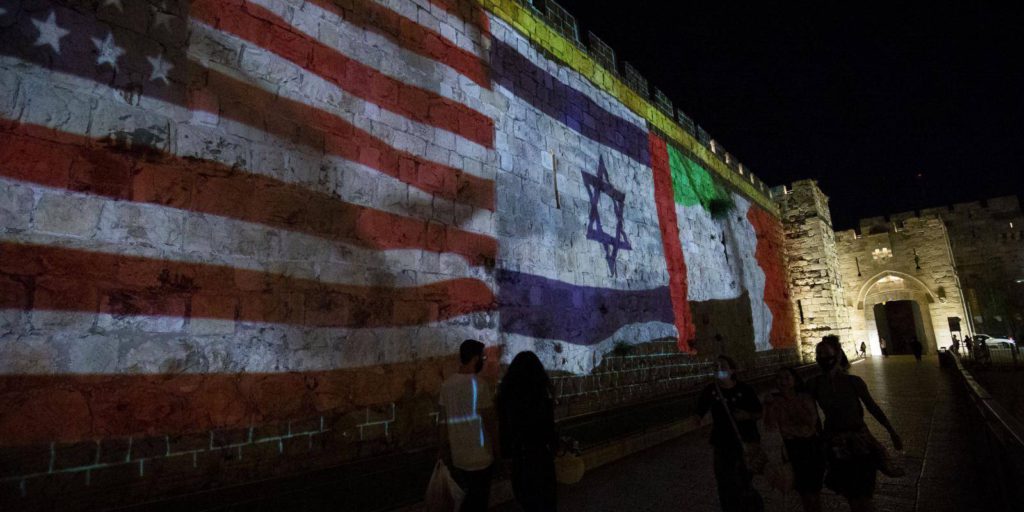
As Lord Palmerston observed that Nations have no permanent friends or allies; they only have permanent interests. This observation helps explain the profound transformation unfolding the Middle East politics. For decades, the Arab countries were reluctant to have formal diplomatic engagement with Israel due to Palestine issue. However, it was UAE which broke the ice by establishing ties with Israel, positioning the decision less as an agreement and more as long-term vision for peace and stability.
Yet normalization was never solely about sustaining ties with Israel by signing agreements, rather careful consideration of a public narrative capable of legitimizing normalization. The strategic use of public diplomacy, soft power initiatives, and media narrative by UAE remained at the forefront of this transition. Initiatives like the Abrahamic Family House, interfaith dialogue campaigns and extensive media coverage of cooperation between both the states. Thereby framing the normalization as prescient step towards peace and stability by constructing it as synonymous with modernization, promotion of national interests, and global integration.
What began as Abraham accords, signed in September 2020, to establish political, economic, and diplomatic relations between UAE and Israel. However, some scholars assert that long before the signing of the agreements, both states had covert relations via intelligence sharing, trade, concerns over Iran’s regional influence, and cybersecurity. These covert relations created the pathways for formal relations.
One of the most important public diplomacy strategies was not portraying normalization as political compromise, but as peace initiative. The Emirati officials characterized Abraham accords as strategic avenue for promoting regional stability, and economic development. Media promoted the narrative of harmony, and modernization portraying UAE as progressive actor capable of transcending historical conflicts. Thus, normalization was associated with innovation and diplomacy instead of ideological betrayal. Furthermore, the normalization was also linked with the suspension of the annexation of the Israeli occupation of the West Bank, arguing engagement would prevent further escalation. Through this, the UAE tried to lessen the public criticism and justify its policy as beneficial for regional peace and stability.
Another powerful tool of UAE public diplomacy is the use of social media platforms to circulate positive image of relations with Israel. Studies analyzing online discourse surrounding normalization disclose how digital campaigns advanced themes of cultural understanding, tourism, and technological advancement. Normalization with Israel was depicted as a symbol of progress via use of hashtags (#AbrahamAccords), statements and interviews of the officials as well as content shared by the influencers on both sides.
The UAE leveraged cultural diplomacy and people-to-people exchanges to normalize relations not only at state level, but also societal. Facilitating tourism and business exchange, direct flights were introduced soon after signing the agreement between Tel Aviv and Dubai. Moreover, joint events in different fields such as technology, healthcare, education etc. were publicized to shore up the idea that normalization would benefit the citizens. Even religious diplomacy played its role as UAE promoted initiatives that boosted interfaith harmony and religious tolerance. As evident from the establishment of Abrahamic Family House in Abu Dhabi, which comprised of mosque, church and synagogue and is a symbol of coexistence.
At economic level, the UAE showcased commercial opportunities in cybersecurity, defense, AI etc. Under the UAE modernization agenda, economic goals were expanded leading to a number of trade agreements-in sectors such as fintech, technology and healthcare, between both the state within the first year of diplomatic engagement. Analysts believed that the normalization not solely resulted in enhancing regional peace, but also opened new economic and strategic avenues.
Beyond economics, another key factor that paved the way for normalization were the security concerns of both the states over the growing influence of Iran in the region. Israel provided advanced defense technologies access to UAE after realizing the declining role of the U.S. in the Middle East. These strategic and defense cooperation further deepened the ties between Israel and UAE. Reports highlighted that cooperation in surveillance technologies, and air defense system shows the strategic dimension of normalization beyond mere diplomacy.
Despite the gains, the normalization process witnessed certain challenges, most importantly a large number of populations still viewed normalization with skepticism. The critics asserted that the normalization gave leverage to Israel without achieving meaningful solution of the Palestine issue. The constant outbreak of violence in Gaza by the Israeli forces puts the UAE in a difficult position, wherein it needed to have equilibrium between regional insensitivities and strategic interests. The UAE’s public diplomacy efforts were badly affected by tensions surrounding Al-Aqsa Mosque, settlement issue along with the military operations carried out by Israel. Through social media, widespread fury across the Arab world intensified as civilian casualties’ images spread, followed by Emirati’s distancing themselves from the Israeli actions.
Bridging the state narrative and the public sentiment became a key challenge in the normalization process. The public diplomacy of the UAE faced limitations as state led narrative run into political and emotional attachment of the public, resulting in clear division between those perceiving the agreements as pragmatic diplomacy and those viewing it as sellout of the Palestinian cause. Nevertheless, the UAE achieved substantial economic, security, and diplomatic benefits from the normalization via various bilateral agreements.
While the UAE tried to institutionalize relations with Israel via economic partnership, and diplomatic engagements, the scope of success rely heavily on whether state-led narrative can override deeply rooted public attachment to the Palestinian cause.

Laiba Afridi
Laiba Afridi is an undergraduate International Relations student and researcher whose work focuses on strategic affairs, public diplomacy, and geopolitical developments across the globe.


Leave a Reply