

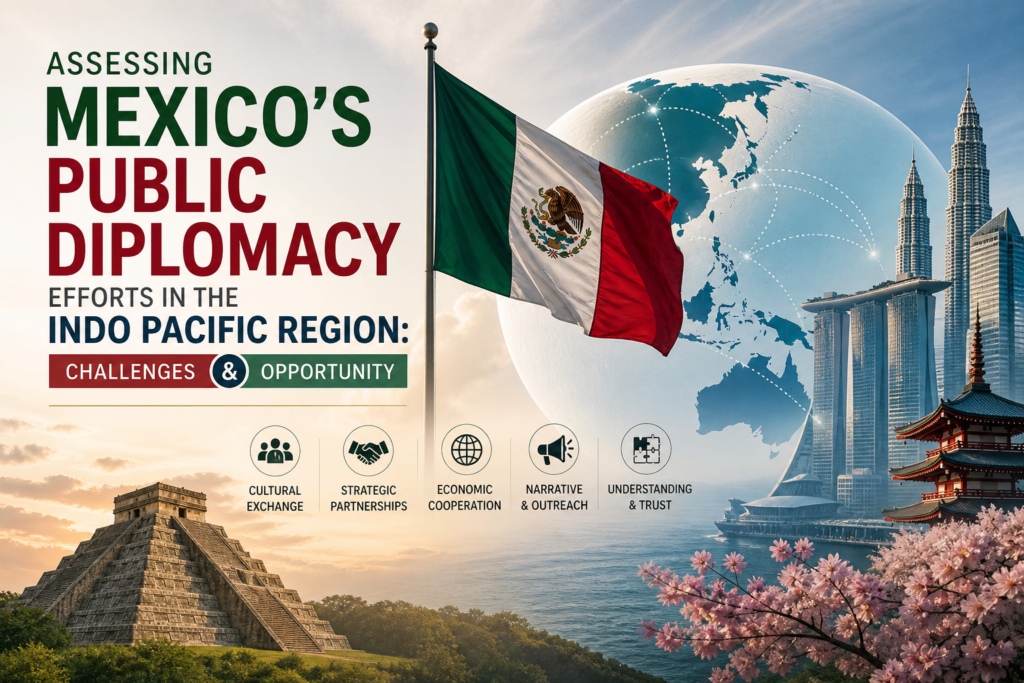
In the last few years, the Indo-Pacific has turned into one of the pivotal arenas in global politics. It’s not just a hub for trade and fast-moving economic growth; it’s also the place where big players are jostling, sometimes subtly and sometimes not, to widen their influence. The United States, China, Japan, India, and Australia are all heavily invested there because the region carries serious strategic weight. In this shifting landscape, Mexico has begun looking more deliberately toward the Indo-Pacific as well. Even though Mexico has long kept its diplomatic center of gravity in North America and Latin America, its rising attention to Asia signals a clear awareness that stronger links beyond its usual orbit matter. A key part of that push is public diplomacy, meaning the work of shaping a country’s image and reach through culture, education, communication, and person-to-person ties. Mexico’s public diplomacy in the Indo-Pacific, then, opens up real opportunities and equally real obstacles, both of which could influence its future standing in international affairs.
Public Diplomacy as a Strategic Tool
Public diplomacy has become a go-to instrument in contemporary foreign policy because governments have figured out that influence isn’t generated only through military muscle or economic coercion. It’s also earned through credibility, cultural pull, and steady, positive engagement with foreign publics. For Mexico, this offers a way to be seen as more than a country associated mainly with migration debates, border politics, or economic reliance on the United States. It gives Mexico room to project its cultural depth, diplomatic principles, and broader global identity. In the Indo-Pacific, where many states are actively seeking diversified partnerships, Mexico can use public diplomacy to build relationships grounded in respect and cooperation. Through art, cuisine, language, tourism, education, and international dialogue, Mexico can develop a more visible presence in a region that has usually sat outside its foreign policy foreground.
Cultural Diplomacy: Mexico’s Strongest Asset
Mexico has a few clear advantages it can lean on in the Indo-Pacific, and cultural identity is near the top of the list. Mexican culture is widely appreciated worldwide for its vivid traditions, music, cinema, cuisine, and historical legacy. Cultural diplomacy can be especially effective because it works on the level of emotion and familiarity, not just policy. In places like Japan, South Korea, India, and Indonesia, curiosity about foreign cultures is growing, and Mexican cultural programming can translate that curiosity into goodwill. Mexican food, for instance, has gained traction in many Asian cities, and that popularity creates a practical doorway into deeper cultural understanding. Film festivals, art shows, musical performances, and academic exchanges can sharpen Mexico’s image and make societies across the Indo-Pacific more conversant with Mexican life and values. It often operates in the background, but cultural diplomacy can yield durable influence that more traditional state-to-state engagement doesn’t always deliver.
Education and Knowledge Exchange
Education is another lane where Mexico can meaningfully scale up its public diplomacy. Student mobility, scholarships, and university partnerships can build thicker, more resilient ties between Mexico and Indo-Pacific countries. People who study abroad frequently carry those relationships for decades, professionally and personally. If Mexico puts more weight behind educational cooperation with universities across Asia and the Pacific, it can help shape a network of future leaders who understand, and perhaps sympathize with, Mexican perspectives. That’s particularly relevant as several Indo-Pacific countries expand their engagement with Latin America. Educational diplomacy also has a practical upside: it can help Mexico absorb lessons from the technological and economic achievements found in parts of the Indo-Pacific. Public diplomacy, in other words, shouldn’t be a one-way broadcast. It should include listening and learning too.
Tourism and Soft Power Projection
Tourism is also a major opening for Mexico’s public diplomacy in the region. Tourism isn’t merely a revenue stream; it’s an engine for national image building. People who visit Mexico often leave with a lived, personal understanding of the country, and that experience can puncture stereotypes and travel further through word of mouth. Mexico’s beaches, historical sites, and cultural festivals are globally recognizable and can appeal strongly to travelers from the Indo-Pacific. As Asian middle classes expand, outbound travel keeps rising, and Mexico could benefit by marketing itself more effectively as a safe, hospitable, and memorable destination. Stronger tourism promotion in countries like China, South Korea, and Singapore can boost Mexico’s soft power while also supporting growth. A traveler who has a great experience in Mexico may later show up again as an investor, a student, or simply someone inclined to support closer bilateral ties.
Structural Constraints and Diplomatic Limitations
Still, Mexico’s public diplomacy in the Indo-Pacific runs into serious constraints. One of the most persistent is limited diplomatic bandwidth. For decades, Mexico’s foreign policy has been shaped heavily by proximity to the United States. Since the United States is Mexico’s largest trading partner and its immediate political neighbour, a large share of Mexico’s diplomatic time and attention has understandably stayed locked on North America. The result is fewer resources, fewer staff hours, and less sustained planning for faraway theaters like the Indo-Pacific. Yet public diplomacy is a long game: it needs continuity, funding, and institutional follow-through. Without that kind of consistent investment, cultural and educational initiatives risk staying modest and ceremonial rather than strategic.
Competing in a Crowded Diplomatic Space
Another hurdle is the level of competition. The Indo-Pacific is already packed with states that treat public diplomacy as a central tool for influence. China advances its profile through infrastructure initiatives, media engagement, and educational institutes. Japan leverages culture, technology, and development assistance. South Korea has built global appeal through entertainment, film, and innovation. India emphasizes democratic credentials and civilizational heritage. Against that backdrop, Mexico has fewer financial and institutional assets to project itself at scale. That doesn’t mean Mexico is out of the running, but it does mean it has to play differently. Instead of trying to match others in size, it needs to compete on authenticity, distinctiveness, and partnerships that feel genuinely mutual.
Language and Communication Barriers
Language adds another layer of difficulty. Spanish is among the world’s major languages, but across much of the Indo-Pacific, English still functions as the default bridge language in international settings. If Mexico wants to communicate more effectively, it has to meet local realities rather than assume Spanish alone will carry the message. That implies more multilingual content, smarter use of digital platforms, and diplomats trained not only in policy but also in Asian languages and cultural codes. Public diplomacy today runs on communication infrastructure. Social media, online education, and digital storytelling can extend Mexico’s reach, but only when the messaging is clear, well-targeted, and culturally aware.
Defining Mexico’s Strategic Identity
Mexico also faces a more conceptual challenge: defining its strategic identity in the Indo-Pacific. In some parts of the region, Mexico may still be viewed primarily as a Latin American country tethered closely to the United States. That perception can limit how seriously Mexico is taken as an independent actor in Asian affairs. To deepen its presence, Mexico needs to show it has its own voice and global interests, not merely a regional role. It can highlight commitments to multilateralism, peaceful cooperation, climate action, and inclusive development. It can also frame itself as a bridge between Latin America and the Indo-Pacific, bringing a perspective that isn’t easily replicated by the usual heavyweights.
Linking Economic and Public Diplomacy
Economic diplomacy should be tied closely to public diplomacy as well. Public diplomacy lands best when cultural and political engagement supports tangible economic partnership. Mexico already participates in major trade arrangements linking it to Asia-Pacific markets, including the Comprehensive and Progressive Agreement for Trans-Pacific Partnership. That creates a concrete platform for deepening trade ties while also strengthening Mexico’s reputation. Businesses don’t just chase numbers; they also look for trust and predictability. If Mexico can sharpen its image as a stable, creative, and cooperative partner, it can attract investment and widen export opportunities.
The Role of Diplomatic Missions
Mexico’s diplomatic missions in the region can also do more heavy lifting. Embassies shouldn’t function only as channels for official government-to-government contact; they can become real hubs for cultural outreach and public engagement. They can convene events, back academic cooperation, and create dialogue with local communities. Diplomats today, like it or not, are communicators as much as negotiators. In a crowded international environment, the ability to tell a coherent national story matters more than ever.
A Cooperative Political Approach
There’s also a political layer to all of this. The Indo-Pacific is increasingly shaped by security concerns, trade frictions, and geopolitical rivalry. Mexico has traditionally favored non-intervention and peaceful dialogue in its foreign policy, and that tradition could be an asset rather than a constraint. In a region where tensions among major powers are intensifying, many countries may welcome partners that emphasize dialogue over confrontation. Mexico can present itself as a supporter of cooperation rather than polarization.
Digital Diplomacy and Future Potential
Digital diplomacy is another area where Mexico could generate fresh momentum. Younger audiences across the Indo-Pacific live online, and states now use digital platforms as a routine way to shape perceptions abroad. Mexico can run smart social media campaigns, host virtual cultural programming, offer online language initiatives, and invest in digital storytelling that reaches people who might never attend an embassy event. Digital diplomacy is often cheaper than traditional forms of outreach and can scale more quickly.
Conclusion: A Gradual but Strategic Path Forward
In my view, Mexico’s public diplomacy in the Indo-Pacific shouldn’t be framed as an attempt to become a dominant regional force. That would be a stretch. It makes more sense as a patient, incremental project: building recognition, trust, and influence in a region that will keep shaping the global order. Mexico doesn’t need to fight superpowers on their own terrain. It needs to identify what it uniquely brings and deploy those strengths with discipline.
Ultimately, Mexico’s public diplomacy in the Indo-Pacific sits at a consequential crossroads. The opportunities are genuine, given the region’s appetite for new partnerships and the fact that Mexico has something real to offer. The constraints are just as genuine, because resources are finite and the competition is intense. Whether Mexico succeeds will depend on moving past symbolic gestures and toward sustained, serious engagement. Public diplomacy isn’t a quick fix, but practiced with patience and purpose, it can generate lasting influence. If Mexico commits to that path, it may find its voice carries further than the Americas, and that its role in the Indo-Pacific can grow larger than many observers currently assume.

Hajra Irshad
Hajra Irshad is a Semester 8 student of BS International Relations at Fatima Jinnah Women University. She writes on global diplomacy and shares her views on “Assessing Mexico’s Public Diplomacy in the Indo-Pacific Region: Challenges and Opportunities.”



Leave a Reply