

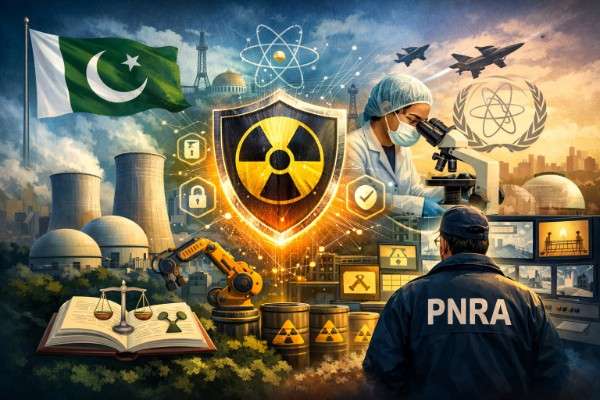
Over the years, Pakistan’s nuclear program has transformed into a multidimensional national asset; from looking after Pakistan’s security needs vis-à-vis India to simultaneously offering valuable derivatives in areas including energy security, medical sciences, industrial applications, and scientific research. However, at the same time, this multi-dimensional expansion of Pakistan’s nuclear program has also come to necessitate extremely immaculate and foolproof safety and security of everything and anything that could even remotely be related to nuclear technology.
As Pakistan traverses its pathway toward a nuclear future; develops nuclear reactors and expands the peaceful applications of nuclear energy, it also requires a credible, effective, and efficient governance infrastructure and regulatory framework that can ensure a safe, secure, and sustainable nuclear future for the country.
For the purpose, in 2001, the Pakistan Nuclear Regulatory Authority (PNRA) was established. Responsible for regulating nuclear facilities in Pakistan, the PNRA is the prime independent regulatory body which has been ensuring the safety and security of all nuclear installations and radiation facilities since its establishment.
In rather specific terms, PNRA has contributed to strengthening Pakistan’s nuclear future through five interlinked pillars. First, it has consolidated a modern legislative and regulatory framework. Second, it effectively oversees Pakistan’s expanding nuclear power programme. Third, it actively contributes to the institutionalisation of nuclear safety, security, and emergency preparedness. Fourth, it supports capacity building through research, training, and infrastructure development. And, fifth, it contributes to international confidence-building and norm diffusion. When taken together, these regulatory efforts allow Pakistan to shape its nuclear future not merely through technological expansion, but also through regulatory depth via credible institutions.
At the legal and structural level, the PNRA anchors its regulatory framework in the PNRA Ordinance (2001), which is its foundational legislation. Additionally, it also issues updated regulations and regulatory guides for ensuring clarity and accountability, while aligning national practices with the safety standards set in place by the International Atomic Energy Agency (IAEA). Most recently, in 2024, PNRA revised its key regulations by adopting performance-based safety oversight and by enhancing transparency through stakeholder consultation.
At the operational level, PNRA has been rigorously regulating Pakistan’s nuclear power plants. In 2024, following exhaustive security assessments, PNRA approved the C-5 nuclear reactor project. Additionally, it also oversees radioactive waste management and spent fuel storage facilities. To PNRA’s credit, Pakistan has not witnessed any major radiological incident under its oversight, with the exception of a minor heavy-water leak at KANUPP in 2011, which was swiftly contained. Moreover, in 2020, PNRA’s regulatory performance contributed to Pakistan ranking among the most improved countries in the Nuclear Threat Initiative’s Nuclear Security Index for weapons-usable materials security, gaining seven points in physical protection and cybersecurity.
It is pertinent to note here that integrating safety culture and emergency preparedness into national resilience frameworks is extremely crucial for any country pursuing a nuclear program. Hence, PNRA facilitates Pakistan in not only complying with international safety standards, but also in establishing itself as a country adhering to global norms. However, more importantly, ensuring human and personnel security, while expanding the use of nuclear energy for medical, industrial, and research applications is critically important at the domestic front as well. Strong safety protocols and practices remain central to the prevention of accidents and radiological hazards, as well as for the protection of public, environment, and critical infrastructure. In this context, PNRA’s work toward integrating safety culture and emergency preparedness has significantly enhanced Pakistan’s ability to manage technical risks.
Hence, by embedding safety, transparency, and professionalism at all levels, PNRA serves as the lynchpin that ensures and promotes a sustained ‘safety culture’ to guarantee a safe, secure, and sustainable nuclear trajectory for Pakistan.
In addition to this, PNRA regulates thousands of medical, industrial, and research radiation facilities across the country. At the same time, it has also been investing in capacity building, research, and regulatory infrastructure to raise awareness among key stakeholders. Together, these efforts enhance Pakistan’s regulatory credibility and demonstrate that the country’s nuclear future is being strengthened not just through technological advancement, but also through governance, competence, and international confidence-building. As a consequence, PNRA also plays an important role in building the overall reputation of Pakistan’s nuclear program. It isan asset that should be further capitalised upon to strengthen Pakistan’s international standing.
However, going forward, PNRA will need to further up the ante by pursuing adaptive regulation. This could be done through responsive rule-making and increased international collaboration in order to enable Pakistan’s long-term nuclear expansion while maintaining safety and resilience. This becomes all the more significant given the fact that technological advancements are occurring at break-neck speed, with nuclear reactors rapidly integrating digital technologies such as advanced sensors, AI-driven monitoring, and networked control systems. At the same time, emerging threats, particularly cybersecurity risks and digital vulnerabilities also render the role of regulatory bodies increasingly significant. Another key challenge lies in the domain of climate change. As climate change intensifies operational risks through water scarcity, flooding, rising temperatures, and seismic stress, there is a growing need for climate-informed licensing, resilient infrastructure requirements, and contingency planning grounded in international standards.
In conclusion, the establishment and operational efficacy of PNRA furnishes a compelling case study of how regulatory institutions particularly in the developing world could evolve into conduits for inter-institutional coordination and the provision of public goods, while simultaneously attaining international legitimacy through rigorous compliance and competence. As Pakistan contends with an increasingly intricate regional and global nuclear order, PNRA’s centrality remains indispensable for safeguarding a nuclear trajectory that is not only secure, but also globally credible and strategically viable.




Leave a Reply