

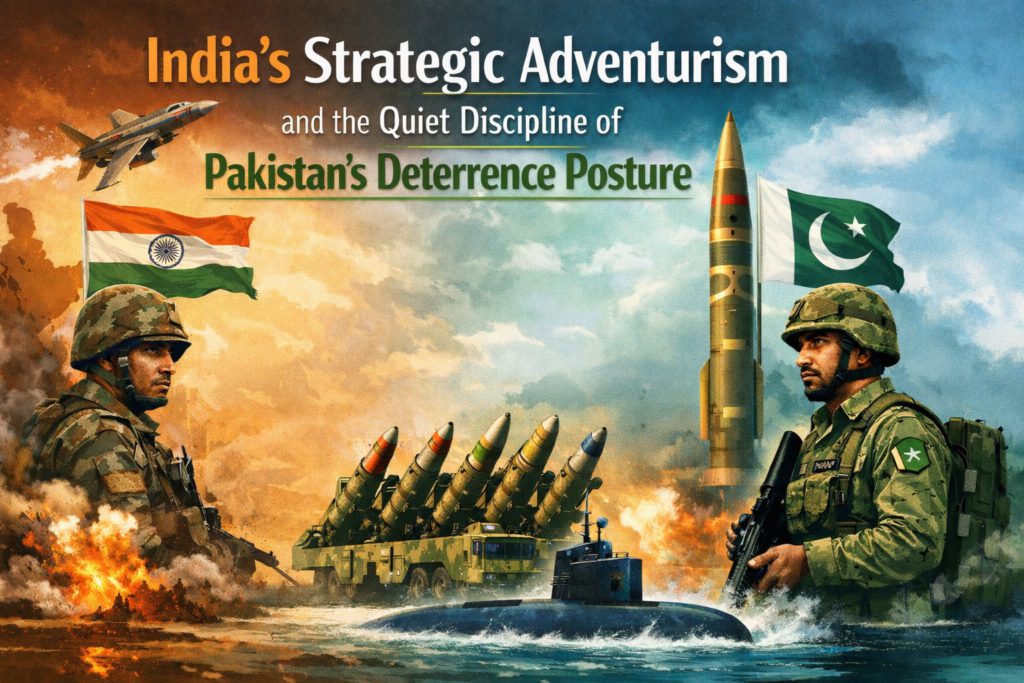
Deterrence in South Asia has repeatedly been tested, largely as a result of India’s evolving doctrines and its willingness to use force under the nuclear umbrella. New Delhi’s reliance on proxy wars, low-intensity conflicts, and increasingly aggressive postures, all shaped, in part, by Hindutva-driven political narrative, has produced recurrent episodes of nuclear brinkmanship in the region.
The May 2025 conflict is instructive in this regard. Pakistan’s response in that crisis remained calibrated and measured, yet it effectively pushed India to reconsider its assumptions about escalation dominance in South Asia. However, Nuclear deterrence remained intact as both sides exercised caution.
The Indian temptation for escalation dominance in the region is also explained in Offense-Defense Theory, which argues that “shifts toward offense dominance are said to generate incentives for preemptive strikes and preventive wars and are also believed to be associated with other war-causing phenomena, such as reduced incentives for negotiated conflict resolution. This framework perfectly complements Indian strategic thinking, where the conventional capabilities differential between India and Pakistan persists, and the resultant asymmetries in power have produced conditions where India harbours the illusion that Pakistan’s deterrence posture is not working effectively against it. The empirical record and May conflict of 2025, however, tells an entirely different story.
The May 2025 Conflict as a Test of Deterrence
Deterrence is not about winning arguments on television. It is about shaping the opponent’s risk calculation. On that score, Pakistan’s deterrent has blocked India from waging a total or decisively dominant war. India’s narrative of escalation dominance has not materialised in practice. In the Balakot–Swift Retort episode or recent crisis, India attempted to craft a strategic image through limited air strikes. Pakistan responded and shot down Indian aircraft twice, and then managed the crisis towards controlled de-escalation. If Pakistan’s deterrent was genuinely weak, India would have had greater space to push further escalation and consolidate dominance. In reality, that did not occur.
Moreover, India continuously propagated that it has created a so-called “new normal” in South Asia that aimed at normalising provocative unilateral military actions under the guise of counter-terrorism. Whereas Pakistan ensured that its full-spectrum deterrence remained intact. Later on, Lt General (R.) Khalid Ahmed Kidwai, in his speech at ISSI Islamabad, mentioned that “Pakistan’s nuclear weapons program had continued to serve as a robust deterrent and the guarantor of peace and stability in South Asia.” Pakistan signalled that it possessed a complete range of responses while choosing to respond in a calibrated and proportionate manner.
In the May 2025 conflict, a destabilising feature of India’s behaviour was its use of the dual-use BrahMos missile. Firing a dual-capable missile in a volatile and time-compressed crisis constitutes highly reckless behaviour. Moreover, India’s continuous missile developments, such as Agni V and any future Agni VI-type system, especially once MIRVed and combined with improved guidance, can be used in principle for precise counterforce strikes. When such missiles are canisterised, kept at higher readiness, and integrated with better ISR and early warning, their time to launch shortens and their theoretical first strike utility increases.
Thus, an adversary cannot know in real time whether an incoming launch is a limited conventional strike, a disarming counterforce attack, or a countervalue salvo. This uncertainty lies at the heart of advertent and inadvertent escalation.
These capabilities support the Indian illusion that escalation dominance can be established. If India assumes that Pakistan’s nuclear arsenal is vulnerable to accurate, time-sensitive attacks, then it may be tempted in a future crisis to threaten or execute preemptive strikes against what it perceives as key nodes. That is a classic route to advertent escalation. In this scenario, Indian military planners appear repeatedly tempted by the idea of launching preemptive strikes against Pakistan, as if they habitually forget that Pakistan possesses an assured second strike capability. Indian scholars, in turn, persistently downplay Pakistan’s deterrent, which is not the behaviour of a genuinely rational leadership. This pattern of thinking resembles a suicide bomber who is clearly warned that an armed guard can shoot him down, yet he proceeds with the attack, accepting the destruction of both himself and others. India’s strategic planners’ illusion that Pakistan’s nuclear posture is a mere bluff reflects a similarly reckless mindset.
Historically, Pakistan’s deterrent posture has been designed primarily with India in mind. Pakistan has demonstrated capabilities that cover a spectrum of ranges vertically from approximately 70 to 2,750 kilometres and horizontally across the tri-services. The launch of the Babur-III submarine-launched cruise missile (SLCM) from naval platforms has signalled a credible and survivable second-strike capability, reinforcing the notion of mutual vulnerability and making the threat of retaliation more robust.
In this context, the statement by the Chief of Defence Forces that credible mutually assured destruction remains a live possibility is not mere rhetoric. Pakistan’s nuclear deterrent is India-centric and rests on the ability to impose unacceptable damage in response to any major aggression. This credibility was recognised in practice. After the loss of Indian aircraft during the May conflict, the Indian Air Force reportedly grounded its fleet for 72 hours, an operational pause that reflected a sober reassessment of risks.
India’s behaviour, both in the May 2025 crisis and in earlier episodes such as the Brasstacks exercise and the 2001–02 standoff, suggests that it has repeatedly tested but ultimately backed off due to Pakistan’s credible deterrent. Even though in the late 1980s, when Pakistan’s nuclear capability was not fully developed, India at that time refrained from crossing the international border, indicating that Pakistan’s deterrence was already credible. Over time, the quantum of India’s desired use of force under the nuclear threshold has been gradually constrained: from earlier doctrines like the Sundarji plan and Cold Start, to surgical strikes, and now to more limited “dynamic response” strategies. This progressive restriction has been induced by Pakistan’s consistent and effective responses.
Furthermore, in the May 2025 crisis, Jaishankar’s call and India’s deliberate decision not to strike Pakistani military targets show that New Delhi clearly feared further escalation. States that believe they hold safe escalation dominance do not ask for de-escalation; they push harder. India did the opposite.
Similarly, after the recent Delhi attack, India neither rushed to blame Pakistan nor launched a panic-driven punitive strike. This restraint indicates that Indian decision makers must absorb the lesson of May 2025 that, under the nuclear shadow, impulsive escalation is genuinely dangerous. When it comes to mere rhetoric, they often put on a bold face, but in reality, they know Pakistan would never in a million years let them achieve decisive escalation dominance.

Sana Ahmed
Sana Ahmad is a Research Associate at the Strategic Vision Institute (SVI) Islamabad.


Leave a Reply